4 minutes
Agentic Commerce Report 2026 Trend 1: Consumers hesitate when money moves
Shoppers let AI agents research and compare on their own. At checkout, most want the final say.

Susan Jackson
Lead, Product & Technology Thought Leadership
Susan Jackson leads thought leadership and content strategy for Global Payments, shaping narratives on agentic commerce, payments innovation, optimisation and emerging technologies for business and technical audiences.
Key points
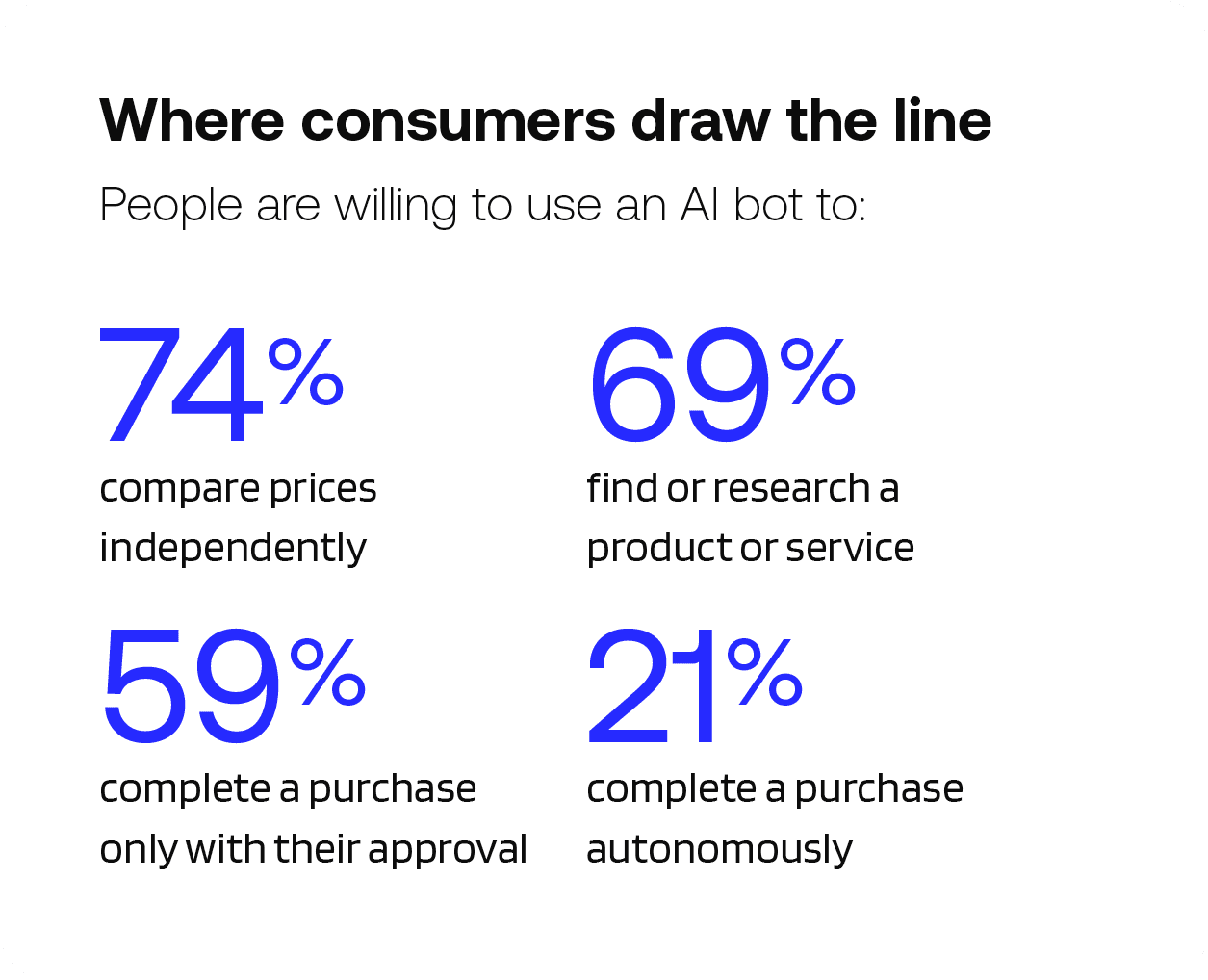
- Among consumers open to AI shopping, 74% would let an agent compare prices on its own and 69% would let it research products.
- Only 21% would let an agent complete a purchase on its own. Another 59% would allow it if they approve each purchase.
- Consumers now want checkpoints before a purchase more than remedies after it. A confirmation step before every purchase is the top trust builder (34%).
- 83% say it matters that no one, including the AI agent, ever sees their actual card or bank account number.
A shopper asks an AI agent to find a cheaper flight, compare three insurers or sum up a few hundred product reviews. They're comfortable letting it do the research. But when it's time to pay, most want to review the details and approve the purchase themselves.
Across all seven markets surveyed, consumers accept AI one task at a time. They're most comfortable using it early in the shopping journey, but that comfort drops sharply at checkout. This is the first trend in our Agentic Commerce Report series.
Consumers already let agents do the legwork
Among consumers open to AI shopping, most would let an agent handle these early tasks without supervision:
- Compare prices: 74%
- Find or research a product or service: 69%
- Consolidate reviews: 68%
- Get a personalised recommendation: 64%
Shoppers who have used AI often describe it as a research assistant. "Instead of reading hundreds of reviews, I ask the AI to summarise the pros and cons and find the best price," said one consumer in Singapore. Another in Singapore used Perplexity to compare insurance, loans and shopping deals. A UK shopper buying an ice maker used two AI agents to compare features, prices and reviews and found it easy.
In each case, the agent gathers information and the shopper makes the decision.
Comfort falls as the agent gets closer to the money
Comfort starts to slip once an agent moves from advising to acting. Just under half (49%) would let an agent build a shortlist or add items to a cart on its own. At payment, the figure drops to 21%.
That doesn't mean consumers won't let agents make payments. Another 59% would allow an agent to complete a purchase if they approve each one. In total, 80% of consumers open to AI shopping would give an agent some role in payment, but most still want final approval.
The pattern holds in every market, but its size varies:
- China is the most willing to let an agent pay on its own, at 39%.
- France and Australia are the least willing, at 16% each. France also has the largest share who wouldn't let an agent complete a purchase at all (33%).
- Brazil has the largest share who want to approve each purchase (67%).
"I'm not comfortable with the payment aspect of AI. It can suggest things or look for certain things, but payments I'll deal with." – US consumer
What worries shoppers at checkout
Security of payment details is the top concern about agentic commerce, cited by 52% of consumers. Next come privacy and use of personal data (46%), AI making the wrong choice (42%) and not knowing who is accountable if something goes wrong (40%).
Consumers' own words show how these worries play out at the point of payment. One UK consumer feared an agent "booking or paying for something without my permission." A consumer in Singapore said "one bug is all it takes to make a big overpayment or wrong purchase." Another UK shopper doubted an agent would pick "the right thing" or use "the right card."
Repeat purchases draw the same caution
The hesitation extends past the first purchase. Only 35% would let an agent reorder items they buy regularly without approval, and 24% would let one manage a subscription. Tracking, returning or managing an order does better, at 49%.
Agents could save shoppers a lot of time on repeat purchases, yet consumers are still reluctant to hand them over.
Consumers want checkpoints, not just refunds
In 2025, consumers mostly asked for ways to undo an agent's mistakes. Fraud protection (54%) and the option to cancel within 24 hours (50%) led that year's list of trust builders. In 2026, the top answers are about stopping mistakes before they happen:
- A confirmation step before every purchase (34%)
- Access to a human customer support agent (30%)
- Proof the AI can't be hacked (30%)
The 24-hour cancellation option has dropped to the middle of the list, at 27%.
Asked how they'd want to approve agent payments, consumers chose steps they take themselves:
- A notification on their phone: 37%
- Biometric verification, such as fingerprint or face ID: 36%
- Email confirmation: 29%
- Bank approval: 26%
Few want to step back entirely. Only 12% would allow automatic purchases up to a spending limit, and 11% would pre-approve businesses with no further confirmation. China is the exception: 30% of Chinese consumers would accept a spending limit.
One point draws near-unanimous agreement: 83% say it matters that no one, including the AI agent, ever sees their card or bank account number. More than half (57%) give this the top rating.
What merchants need to know
- Start with discovery. Three in four consumers open to AI already let agents compare prices. Product data, pricing and reviews need to be easy for agents to read.
- Design the approval step. A quick confirmation by push notification or biometric check matches how most consumers want to approve agent purchases.
- Keep payment credentials hidden. Tokenisation lets an agent complete a payment without exposing card or account numbers.
- Say who's accountable. Four in ten consumers don't know who is responsible when an agent purchase goes wrong. Clear support and dispute paths help answer that question.
- Plan market by market. Consumers in China accept more autonomy. France and Australia need more checkpoints.
The bigger picture
Just 16% of consumers say nothing would make them comfortable with an AI agent buying for them. Most shoppers can see how an agent might help. Their main concern is how much control they keep once money is involved.
Read the full report
Download the full report for complete market and category findings. Then follow our Insights series. Next up: AI agents are expected to gain purchase share.
Related insights